


Use microRNA-200c in Endometrial Cancer Treatment with Bioinformatics Tools
Abstract 1Young Researcher and Elite Club, Borujerd Branch, Islamic Azad University, Borujerd, Iran 2BS, Department of Biology, Payamnoor University of Qom, Iran 3Department of Biology, School of Basic Sciences & Bioinformatics Research Group, University of Qom, Qom, Iran
Keywords Treatment; miR-200c; endometrial cancer
Pdf Download
Citation Manager
Copy the following to cite this URL:
https://yourjournal.com/article/xyz123
Introduction:
Introduction Every year, endometrial cancer afflicts 14200 women in the world and every year 42000 of afflicted people die. The most samples diagnosed by doctors are after menopause; of course the most dispersion is about 70 years of old. Generally for %80 of afflicted people the survival chance, from diagnosis, is predictable by type 2 is hardly predictable as this type is likely to return even in its first stages. So surgery is the fundamental treatment to this cancer(Amant, Moerman et al. 2005). MicroRNAs are group of non-coding RNAs being 18-25 nucleotides long and after transcription they affect gene expression. They do this by pairing with complement sequence being placed in 3’UTR area related to target RNA(Price and Chen 2014). Some studies report them also in coding sequences and even promoters (Le Quesne and Caldas 2010, Almeida, Reis et al. 2011). The first study, related microRNAs to cancer, was done a lymphocytal leukemia patient. Kalin and et observe that in about %50 of these patients, cluster genes (of) miR-150, miR-16 are deregulated or omitted. In fact their repressing tumor role was recommended. Consequently the same group provided the significant percentage of microRNA’s map and observed that %52.5 of them fare been placed in connected, breakable and cancer areas. In 2005 the first report on deregulation of 29 of microRNAs in cancer was published (Esquela-Kerscher and Slack 2006, Almeida, Reis et al. 2011). A treatment by microRNA can be done in two ways; the first one by inhibition of microRNA expression and the other one through microRNA substitution, i.e. microRNAs functioning as tumor suppressor and deregulated in cancer tissue are substituted by external microRNA or oncomir action is inhibited in a way. Then based on the way microRNA acts, they can be targeted at two different levels of increasing their area or interference in the reaction between messenger RNA (mRNA) and microRNA (Kota and Balasubramanian 2010, Sotillo and Thomas-Tikhonenko 2011). miR-200c is a family of microRNA having various kinds (miR-200a, miR-200b, miR-200c) which are used in this study by taking miR-200c as miR-200c’s have an important role in keeping epithelial cells and cause inhibition of EMT (Epithelial to Mesenchymal Transcription) and cell migration and cell movement and also inhibition of proteins having role in ATPase and inhibition of ZEB1.2. E-cadherin inhibitors have an important role in non-existence of cancer in cells and these important role of miR-200c has differentiated this microRNA from other microRNAs and make it a proper candidate for treatments(Cochrane, Spoelstra et al. 2009, Howe, Cochrane et al. 2011). Material and Methods A selected experiment was planned to know the genes regulated by miR-200c in aggressive cancer. Then miR-200c was poured into endometrial cancer tissue and diagnose the genes regulated by miR-200c, the treatment sample was examined by normal sample by microarray technique. Microarray data series GSE25332 was extracted by NCBI [http://www.ncbi.nim.nih.gov] and platform: [HG.U133-plus-2] Affymetrix human genome U133 plus 2.0 GPL570 Array, from data bank Gene Expression Omnibus (GEO). Three sample of data were divided as a control sample (by 3 repetition), minus control (with (by) 3 repetition) and miR-200c which was our treatment sample. All were taken from endometrial cancer tissue. To compare control and treatment groups (miR-200c) we omitted minus control sample and compare 3 repetition of miR-200c to control repetitions. The above mentioned data, after extraction to analyze the microarray data to find the genes having differential expression in miR-200c groups compared to control group, were taken to web program GEO2R (http://www.ncbi.nlm.nih.gov/geo/geo2r) and by considering the criterion (Adj.p-value<0.01 and LogFC >1) consequently after analyzing, it was known that 85 genes have had differential expression and 54 genes up regulated to validate the microarray analysis (Barrett, Wilhite et al. 2013), the genes list in function(operation) tools of the genes having differential expression: 85 genes extracted in database DAVID (www.david.abcc.ncifert.gov) went under functional Annotation clustering(Dennis, Sherman et al. 2003, Huang, Sherman et al. 2007, Sherman, Huang da et al. 2007). Analysis by BioGPS. The extracted genes by BioGPS tools (www.biogps.org) were examined by comparing them to another 144 microarray banks to find the place on gene expression in normal samples (Su, Cooke et al. 2002, Wu, Macleod et al. 2013).
Results Comparing of microarray data in the treatment sample (induction of miR-200c into endometrial cancer) and control sample (Endometrial Cancer) to each other leads to find 85 kinds of genes with differential expression that in these review 31 genes were inhibited by miR-200c and 54 kind of genes up regulated by miR-200c (Fig.2). The 54 genes which up regulated are which the genes CDH1, ARL14, MAL2, ARHGDIB and CDS1 are the first genes which have increased expression (Log-FC= 3.55, 188, 182, 1.8 and 1.13, respectively). As an example the gene coding the CDHI and having the most expression increase, have had the basic role in cell bindings and keeping the specific shape or differential and somatic cell in its operation place. In most cancers this genes are attacked and inhibited and its control causes The E-Cadherin protein not to be produced, and then somatic cells, by losing their bindings, will lose their spatial shape gradually and change into a cancer shape, The results conform to the previous knowledge of cancer (Fig.2).
But the 31 genes attacked and controlled by miR-200c in endometrial cancer, means that these 31 kind of genes have been activated in endometrial cancer and have increased expression, but after the presence of miR-200c have down regulated, and this decrease was to the amount that has been treated as differential expression, i.e. their Fold-change score(FC-score) has been raised equal or less than -1 unit meaning that the expression has been decreased as twice which shows the significance of the transcription measure resulted by genes. From these 31 genes, the five first genes which have experienced the most change are OMTM1, QKI, ZEB1, HOMX1 and FN1, respectively, whose FC-score are -1.94, -1.61, -1.64, -1.55, -1.45 respectively. OMTM1 has down regulated near fourfold, and as it is clear their expression measures are near to each other. (Table.2). BioGPS Analysis The gene OSTM1 codes a protein having a transitional role in Osteoporosis cells and in some parts of body as retina and epithelial cells of bronchus has high expression in normal condition. Examination of QKI in 174 microarray banks shows that this gene has the highs expression in monocyte and Myeloid cells. ZEB1 analysis in 174 microarray banks shows that this gene has its highest expression in uterine cells and this gene represents firstly the correctness of analyses and secondly the probably important of this gene’s role in endometrial cancer (Fig.1). HMOX1 analysis showed highest expression in this gene in monocyte, NK cells and endothelial CD105. FN1 analysis in 174 microarray data showed highest expression in this gene in placenta, smooth muscles cells, the cells producer of fat, that its importance in its expression in smooth muscles explains its high expression presence in endometrial cancer cells. DAVID Analysis But after functional assess of the two groups of gene (Up regulate-Down regulate) by DAVID the following results were obtained. In the first group genes inhibited (controlled) by miR-200c, DAVID tool diagnosed 30 genes from 31 genes and in 30 genes no significant common function was found. But in the second group, extracted by microarray analysis sample, from 54 extracted genes, 53 genes were diagnosed by DAVID and from 53 genes, 7 genes were found as cell junction (Table1). Table1: The genes from up regulated genes which are about 54 genes, 7 genes of which have significant function in cell junction diagnosed by DAVID.
For the first time, after assess on the up regulated genes, 12 genes of 54 genes, having significant in treatment group have been reported in this study. It means that these genes have had lower expression or on expression and after induction of miR-200c into treatment group, their expression has increased. From 12 genes not reported in the studies related to miR-200c, causing their increase expression, 6 genes were diagnosed by BioGPS analysis and their comparing to 174 microarray banks, which have the same (common) roles as housekeeping genes in all part of body which are ARL14, TMEM80, TENM2, DOK7, DCAF12L1, SLC25A45 having the roles of Ribozillation, transition in transitional membrane, connector in protein membrane, relating factor and salt carrier in all part of body, respectively. But from the other 6 genes, 2 genes LOC554207, LOC729680 have no role in any bank and no place for expression. From the 4 genes, not reported and influenced by miR-200c causing their increase expression, PLAC8, AKR1D1, ANXa3, ESYT2 have a high expression in NK cells, epithelial cells of bronchus, live, embryo liver, dendrite cells and burkit’s lymphoma, respectively after comparing to 174 microarray data (Table.2). Table2: 12 genes not reported from 54 genes having increase expression by miR-200c in endometrial cancer.
In down regulated genes being inhibited by miR-200c, 10 genes were reported for the first time in this study, from which TUBB4A, DIRAS2 have high expression in all parts of brain. Also the two genes TLL2, RIPPLY1 have high expression in all parts of body, as housekeeping genes, except for endometrial cancer. The two genes RHOJ, OAF having high expression endometrial cancer show not expression by comparing 174 microarray data. Only the three genes L3HYPDH, THEMIS, SLC17A3 from the 9 inhibited genes, have high expression in some significant points as smooth muscle cells, monocytes, myeloid and kidney cells (Table.3). Table3: 9 non-reported genes from the 31 genes inhibited by miR-200c in endometrial cancer. Which are reported from the first time in this article.
Discussion The results by this study showed that miR-200c can be a medium for treatment of endometrial cancer. For the high influence of miR-200c on different components of cancers resulted by stem cells or some cancer with stem cells origin, miR-200c by playing role in inhibition of TGFB, SEMT, ZEB1,2, β-Catenin, BMI1 and having role in various cancers specially those related to stem cells, cause miR-200c treatment to be a hope for endometrial cancer treatment. Many researches have been conducted in this way (Sun, Jiao et al. 2014). Also the findings of this study have reported 9 genes inhibited by miR-200c for the first time. From these 9 genes 3 genes (L3HYPDH, THEMIS, SLC17A3) are treated more important than the 6 other genes for their expression in other areas like smooth muscle cell, Monocytes and Myeloid and it is recommended that a Polymerase Chain Reaction(PCR) technique is taken from these 9 genes in treatment sample to confirm candidates (Table.3). In this study, for the first time 12 genes are reported as candidates genes that miR-200c has caused their up regulated and it is recommended that, for their final confirm, researchers take PCR technique of 12 up regulated genes is treatment samples, and confirm the result of this study (Table.2). From these non-reported candidate genes before this study, these 4 genes ESTY2, ANXA3, AKR1D1 and PLAC8 have more important role in endometrial cancer which has high expression in NK cells, bronchus epithelial cells, liver and uterus liver, Dendrites and Burkitt's lymphoma. Seven genes from up regulated genes, by DAVID Analysis, showed that they have function in cell conjunction and from which DOK1 are the only candidate gene is this study which has up regulated by miR-200c (Table.1). It is hoped that these candidate genes, in this study, will be used in treatment of endometrial cancer in future. Also there are still some questions like which factors influence miR-200c? And how can understand the exact functionality of miR-200c during cancers treatment, which have not been responded yet. It is hoped that a cure of cancers by microRNA will be obtained someday and to do this more Bioinformatics and clinical studies are required (Iguchi, Kosaka et al. 2010, Andorfer, Necela et al. 2011). Acknowledgement This study support with Fatemeh Salarian. Reference
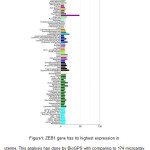 |
Figure1: ZEB1 gene has its highest expression in uterine. This analysis has done by BioGPS with comparing to 174 microarray librariesClick here to View figure |
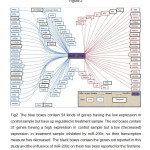 |
Figure2: The blue boxes contain 54 kinds of genes having the low expression in control sample but have up regulated in treatment sample. The red boxes contain 31 genes having a high expression in control sample but a low (Decreased) expression in treatment sample inhibited by miR-200c, so their transcription measure has decreased. The black boxes contain the genes not reported in this study and the influence of miR-200c on them has been reported for the first time.Click here to View figure |
| Gene Name | Gene.title |
| MARVELD2 | MARVEL domain containing 2 |
| CDH1 | Cadherin 1, type 1, E-cadherin (epithelial) |
| CGN | Cingulin |
| DOK7 | Docking protein 7 |
| EPB41L5 | Erythrocyte membrane protein band 4.1 like 5 |
| PPL | Periplakin |
| PKP2 | Plakophilin |
| Gene Name | LogFC |
| ARL14 | -1.88 |
| LOC729680 | -1.55 |
| ESYT2 | -1.38 |
| TMEM80 | -1.25 |
| TENM2 | -1.19 |
| ANXA3 | -1.16 |
| DOK7 | -1.12 |
| LOC554207 | -1.07 |
| AKR1D1 | -1.06 |
| DCAF12L1 | -1.05 |
| PLAC8 | -1.02 |
| SLC25A45 | -1.01 |
| Gene Name | LogFC |
| RIPPLY1 | 1.35 |
| RHOJ | 1.3 |
| OAF | 1.18 |
| L3HYPDH | 1.1 |
| THEMIS2 | 1.06 |
| SLC17A3 | 1.06 |
| TLL2 | 1.02 |
| DIRAS2 | 1.02 |
| TUBB4A | 1.01 |
- Almeida, M. I., R. M. Reis and G. A. Calin. "MicroRNA history: discovery, recent applications, and next frontiers." Mutat Res 717(1-2): 1-8 (2011).
- Amant, F., P. Moerman, P. Neven, D. Timmerman, E. Van Limbergen and I. Vergote. "Endometrial cancer." Lancet 366(9484): 491-505 (2005).
- Andorfer, C. A., B. M. Necela, E. A. Thompson and E. A. Perez. "MicroRNA signatures: clinical biomarkers for the diagnosis and treatment of breast cancer." Trends Mol Med 17(6): 313-319 (2011).
- Barrett, T., S. E. Wilhite, P. Ledoux, C. Evangelista, I. F. Kim, M. Tomashevsky, K. A. Marshall, K. H. Phillippy, P. M. Sherman, M. Holko, A. Yefanov, H. Lee, N. Zhang, C. L. Robertson, N. Serova, S. Davis and A. Soboleva. "NCBI GEO: archive for functional genomics data sets--update." Nucleic Acids Res 41(Database issue): D991-995 (2013).
- Cochrane, D. R., N. S. Spoelstra, E. N. Howe, S. K. Nordeen and J. K. Richer. "MicroRNA-200c mitigates invasiveness and restores sensitivity to microtubule-targeting chemotherapeutic agents." Mol Cancer Ther 8(5): 1055-1066 (2009).
- Dennis, G., Jr., B. T. Sherman, D. A. Hosack, J. Yang, W. Gao, H. C. Lane and R. A. Lempicki (2003). "DAVID: Database for Annotation, Visualization, and Integrated Discovery." Genome Biol 4(5): P3.
- Esquela-Kerscher, A. and F. J. Slack. "Oncomirs - microRNAs with a role in cancer." Nat Rev Cancer 6(4): 259-269 (2006).
- Howe, E. N., D. R. Cochrane and J. K. Richer. "Targets of miR-200c mediate suppression of cell motility and anoikis resistance." Breast Cancer Res 13(2): R45 (2011).
- Huang, D. W., B. T. Sherman, Q. Tan, J. Kir, D. Liu, D. Bryant, Y. Guo, R. Stephens, M. W. Baseler, H. C. Lane and R. A. Lempicki. "DAVID Bioinformatics Resources: expanded annotation database and novel algorithms to better extract biology from large gene lists." Nucleic Acids Res 35(Web Server issue): W169-175 (2007).
- Iguchi, H., N. Kosaka and T. Ochiya. "Versatile applications of microRNA in anti-cancer drug discovery: from therapeutics to biomarkers." Curr Drug Discov Technol 7(2): 95-105 (2010).
- Kota, S. K. and S. Balasubramanian. "Cancer therapy via modulation of micro RNA levels: a promising future." Drug Discov Today 15(17-18): 733-740 (2010).
- Le Quesne, J. and C. Caldas. "Micro-RNAs and breast cancer." Mol Oncol 4(3): 230-241 (2010).
- Price, C. and J. Chen. "MicroRNAs in Cancer Biology and Therapy: Current Status and Perspectives." Genes Dis 1(1): 53-63 (2014).
- Sherman, B. T., W. Huang da, Q. Tan, Y. Guo, S. Bour, D. Liu, R. Stephens, M. W. Baseler, H. C. Lane and R. A. Lempicki. "DAVID Knowledgebase: a gene-centered database integrating heterogeneous gene annotation resources to facilitate high-throughput gene functional analysis." BMC Bioinformatics 8: 426 (2007).
- Sotillo, E. and A. Thomas-Tikhonenko. "Shielding the messenger (RNA): microRNA-based anticancer therapies." Pharmacol Ther 131(1): 18-32 (2011).
- Su, A. I., M. P. Cooke, K. A. Ching, Y. Hakak, J. R. Walker, T. Wiltshire, A. P. Orth, R. G. Vega, L. M. Sapinoso, A. Moqrich, A. Patapoutian, G. M. Hampton, P. G. Schultz and J. B. Hogenesch. "Large-scale analysis of the human and mouse transcriptomes." Proc Natl Acad Sci U S A 99(7): 4465-4470 (2002).
- Sun, X., X. Jiao, T. G. Pestell, C. Fan, S. Qin, E. Mirabelli, H. Ren and R. G. Pestell. "MicroRNAs and cancer stem cells: the sword and the shield." Oncogene 33(42): 4967-4977 (2014).
- Wu, C., I. Macleod and A. I. Su. "BioGPS and MyGene.info: organizing online, gene-centric information." Nucleic Acids Res 41(Database issue): D561-565 (2013).

Article Metrics
 Views:
 PDF Downloads:
Citations

Publishing History
Review Details
Cite this article Cite

Cite

Help
author resource
ugc-care journal

member of

journal archived in

partenered with

visit us on


